FOR AUTHORS
What Should Authors Post on Social Media Between Releases?
What should authors post between releases? A balanced mix of story, process and reader posts, series reminders, countdowns and a weekly plan.

A page-by-page guide to the author website readers, bloggers and event organisers actually use, from the home page to the privacy notice.
An author website should include a home page that says who you are and what you write, a page for each book or series with buy links, and a clear reading order. Then add an about page with your photo and a newsletter sign-up, plus media and contact pages. UK sites also need a privacy notice and cookie consent.
Most author websites fail in one of two directions. Some are so thin that a curious reader can’t tell which book to start with. Others are stuffed with widgets and stale news, plus every review the author has ever received. Neither one helps the person who has just turned the last page of your novel and wants to know what to read next, and that person is the reason an author website exists at all.
Below are the pages worth building, roughly in the order most authors need them, and what to put on each.
Start with the visitors, not the pages. Four groups turn up on author sites:
Each page should do a job for at least one of them. If you can’t say which, you probably don’t need that page.
A visitor gives your home page a few seconds. In that time it has to tell them who you are, what you write and where to click next.
Readers use this page more than any other. Sort it out first.
Give every book its own page. Put the cover on it with a short blurb and a handful of strong review quotes, plus the series name and the book’s number in it, then buy links for each format and retailer you sell through. Search engines also find separate book pages more easily than one long list.
Writing a series? Then a reading-order page is one of the most useful things you can put online. List every book in sequence with its cover, and say whether each one works as a standalone.
Don’t push every reader towards a single shop. Link to each retailer you’re on and to the audiobooks. If you sell direct, link to your own store as well. A reader outside the UK should be able to find their own local store just as easily.
Readers are curious about the person who wrote the book. They don’t want your CV. Keep the tone warm and easy, and tie your life to your writing where it fits: where you live, why your subject pulls you in, what you did before you started writing.
Use a good author photograph. Readers, journalists and organisers look for it almost straight away, and a tired old selfie drags down everything around it. Our guide to author photos that sell books covers how to plan the shoot, and brand photography can give you a set of pictures that work on the website and the books as well as in the press.
Your mailing list is the one audience you own outright. That’s why people so often call the newsletter sign-up the most important part of an author site.
So give it a page of its own, and keep a form on the home page too. Tell people what they’ll get and how often. Then offer something for signing up: a free short story, say, or a prequel, or a first look at new covers.
Get consent right. In the UK you generally need specific consent before you send marketing emails to individuals, and each email has to include an easy way to opt out (ICO). Keep a record of how and when each person signed up.
Yes, if you’re after interviews, festival slots, library talks or bookshop events. It stops you emailing the same attachments over and over. Put these on it:
Video earns its place on this page. A brief interview or a reading lets an organiser see how you come across in a room, and brand videography can give you clips for the website and for social media.
| Page | When it’s worth it |
|---|---|
| Events | When you do regular signings, talks or festivals |
| News or blog | Only if you’ll update it; otherwise use your newsletter |
| Extras | Maps, character guides, deleted scenes or book club questions for engaged readers |
| Shop | If you sell signed copies or direct ebooks |
| FAQ | When readers keep asking the same questions about series order or release dates |
| Contact | Always: a simple form or address, with routes for readers, press and rights |
This isn’t legal advice. These are the basics to check against the official guidance.
First, a privacy notice. If you collect names or email addresses, say what you collect and why, and how long you hold on to it.
Second, cookie consent. According to the ICO, non-essential cookies need consent given by a clear positive action, and they shouldn’t be set until the visitor agrees, though strictly necessary cookies are usually exempt (ICO). The ICO says this guidance is under revision, so check the latest version.
Third, your own domain, in your author name. A .co.uk suits authors who mainly sell in the UK. Avoid a domain named after one genre or one series, because you may well outgrow it.
Fourth, phones. People open links from social media and emails on their phones more often than not, so look at every page on a small screen. And keep the site light. Huge uncompressed images and a pile of plugins will slow it down.
No. Just starting out? A single page with your name and books on it is plenty, as long as it also carries a newsletter sign-up and a short bio with your contact details. Book pages and a reading order can come later as the list grows, followed by a media page. Still unsure whether you need a site at all? Read do you need an author website if you’re self-published?
Once you want something more considered, a personal brand website built around your books and author brand pulls it all together, with a design that matches your covers and copy that sounds like you.
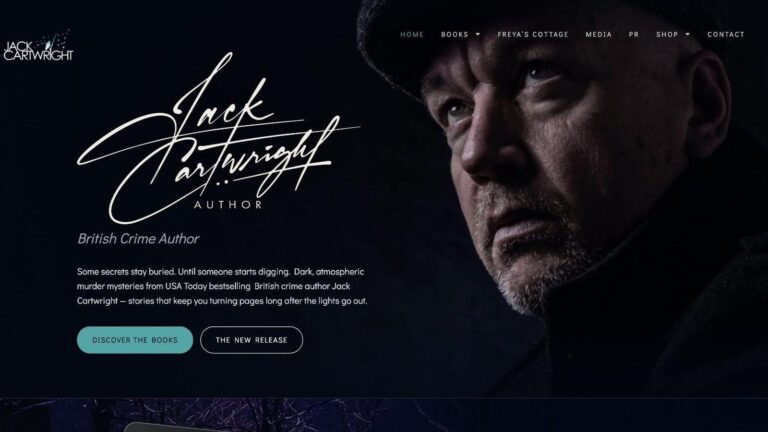
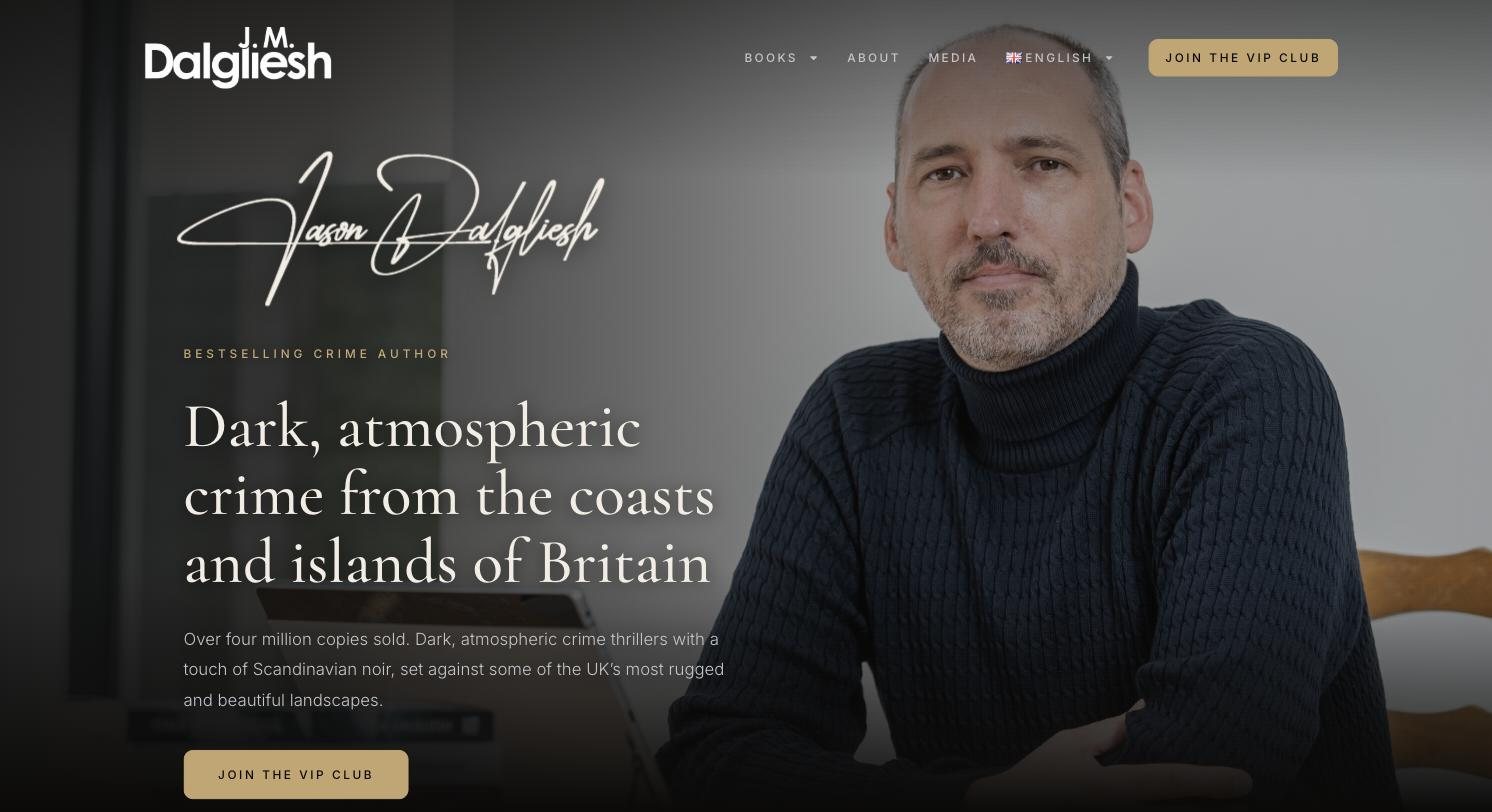
We started out as the in-house team for our founder, USA Today bestselling author Jack Cartwright. We designed and built his author website and J M Dalgliesh’s too. Today we design and build author websites on WordPress with the copy and SEO foundations included, and we can add author photography and video. We agree the scope and fee with you before any design work begins. Websites are one part of our book marketing services for self-published authors.
Only as many as it takes to do the job well. A new author can get by with one page. If you have several series, you’ll usually want a home page plus book and series pages and a reading order. Then add about and newsletter pages, with media and contact pages alongside. Add more only when readers need them.
Yes, but pick a few short, strong quotes for each book instead of pasting in the lot. Quotes from publications people recognise, other authors, or readers with a clear source carry the most weight. Keep every quote accurate and attributed.
Only if you’ll keep it up and readers want what you’d write there. Plenty of authors find a newsletter does the job better, because it lands straight in the reader’s inbox. For most, an occasional news page is enough.
Usually, yes, if each pen name writes for a different readership. Crime readers and romance readers want different things. If you’d sooner link the names openly, one site with clearly separate sections can work, but ask yourself whether readers would get confused.
For most authors it’s the books page and the newsletter sign-up. The books page turns curiosity into sales. The newsletter turns a one-off reader into someone you can tell about your next book.
What should authors post between releases? A balanced mix of story, process and reader posts, series reminders, countdowns and a weekly plan.
Learn how to give every book in a series a consistent look, with colour per book, clear numbering, box set covers and refreshes that help read-through.
Why indie authors sell ebooks, paperbacks and audiobooks from their own site, how delivery works, and what to check on VAT and KDP Select first.
Four quick questions, and we’ll show you where we’d start. Your answers come straight to us with your message, so you won’t have to explain it twice.
A 30-minute introduction call on Microsoft Teams, Monday to Friday, 9am to 5pm. Your answers come with the booking, so we’ll be ready for you.
Prefer to talk it through? Make an appointment for a 30-minute call on Microsoft Teams, Monday to Friday, 9am to 5pm.
A closer look at the work behind each part of your plan.
We use analytics cookies to understand how visitors use our site. They are only set if you accept. Read our privacy policy.