FOR AUTHORS
What Should Authors Post on Social Media Between Releases?
What should authors post between releases? A balanced mix of story, process and reader posts, series reminders, countdowns and a weekly plan.

How to write a 30 to 60 second book trailer script from your blurb, with versions for ads and vertical video and the licensing basics.
A good book trailer script runs 30 to 60 seconds and is built from your blurb. Open with a hook line. Add two or three beats of stakes and mood, then finish on the title and your name with one call to action. Keep on-screen lines readable in two seconds, and cut a shorter vertical version for ads.
When authors struggle with a trailer, they usually have the footage and the music. What’s missing is a book trailer script. Without one the edit wanders off, the on-screen text runs long and the ending forgets to tell anyone what to do next, which is the one job it really has. The script doesn’t have to be clever. It has to be tight, and it should sound like your book.
Still deciding whether a trailer is worth making? Our guide to book trailers and author videos makes the case. This article is about the writing. If you’d sooner have it filmed and edited for you, our book trailer and author video production is there when you need it.
Aim for 30 to 60 seconds, and write the 30-second version first. If it works at 30, you can add a beat or two for a longer cut on your website or YouTube. Start at 60 and you’ll find it painful to cut down later.
In practice that’s roughly eight to twelve short lines of text or voiceover. A paragraph of blurb won’t work. People watching on a phone won’t sit through a slow build while they work out what kind of book this is, so the hook has to land in the first three seconds.
Your blurb has already done the hard part, which was picking the most compelling angle. Don’t paste it in. Pull out one line that makes a reader ask a question, then rewrite it shorter.
Name your tropes plainly where they help. Readers search by trope on BookTok and Bookstagram, so “grumpy and sunshine” or “locked room” does a lot of work in very few words. Comp authors can do the same job. Use them sparingly, and only where the comparison is honest.
Think in beats. Sentences come later. Here’s a shape that works for most genre fiction.
| Beat | Roughly when | What it does |
|---|---|---|
| Hook | 0 to 3 seconds | One line that raises a question |
| Situation | 3 to 12 seconds | Who the character is and what they want |
| Stakes | 12 to 25 seconds | What goes wrong, or what it will cost them |
| Mood and tropes | Throughout | Music, colour and pace that match the genre |
| Title card | Last 5 to 8 seconds | Title, series name, your name, cover image |
| Call to action | Final 3 seconds | One thing to do next |
If you write a series, say so. “Book one of the Harbour Lane mysteries” tells a reader there’s more waiting for them, which helps read-through. It also gives you a reason to keep running the trailer long after launch week.
Most people first watch a trailer with the sound off. So the text has to carry the story. Write it as though there’s no voiceover at all.
Read the script aloud with a stopwatch running. Run out of breath or time? Cut a line. Then show it to someone who hasn’t read the book and ask them what they think it’s about, because if their answer is miles off, the script needs another pass before anyone starts editing footage.
Write one master script and cut versions from it. In ads and vertical video the hook does most of the work, so it moves right to the front and everything after it gets shorter.
Test two or three hooks against each other. Don’t just trust your first instinct, because the same footage with a different opening line can perform very differently once real readers start scrolling past it.
Trailers go wrong here more than anywhere else. Check it before you export, not after you’ve posted.
Whenever you reuse a trailer on another platform, check the music again. A licence for one platform doesn’t automatically cover the next.
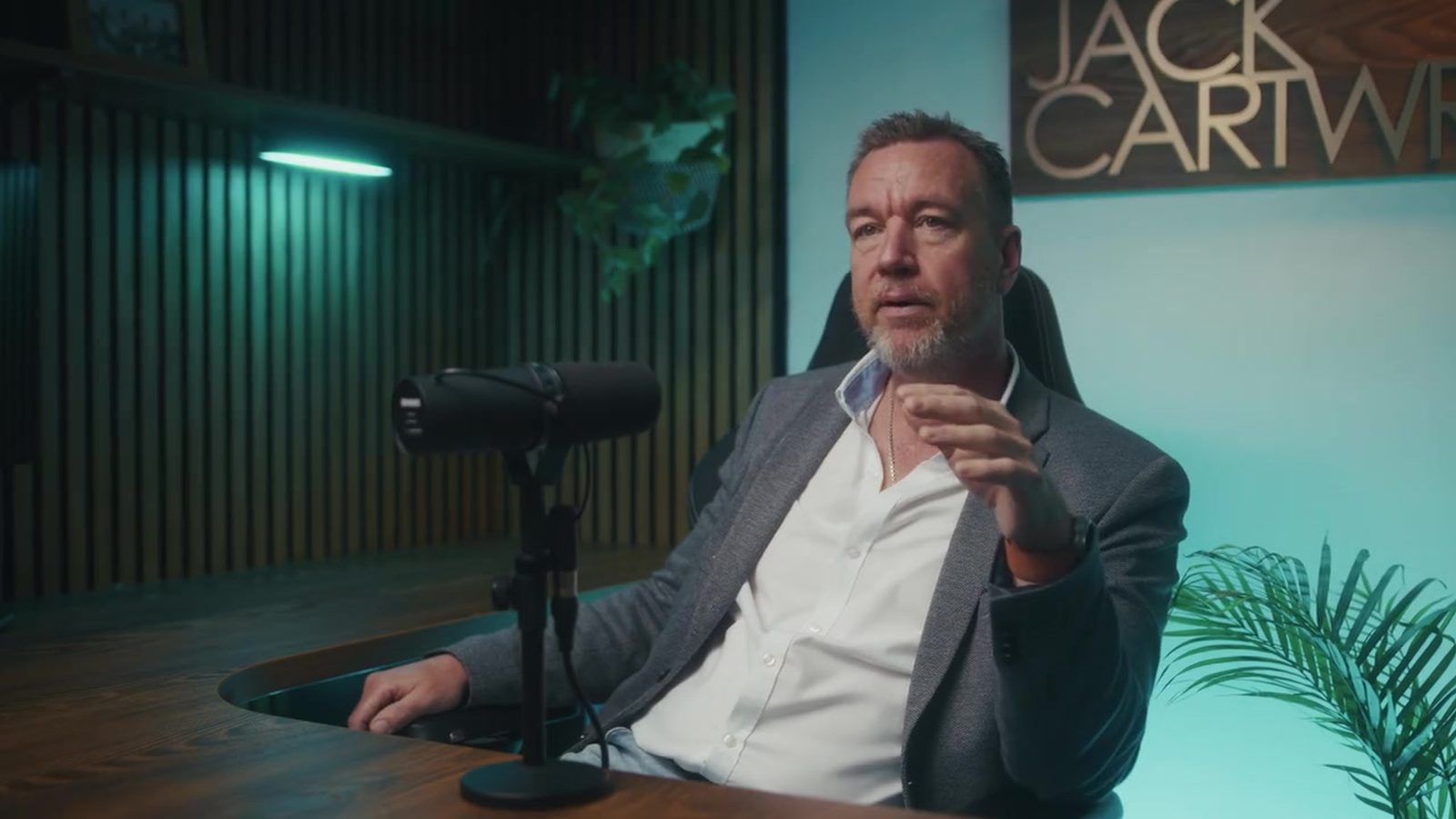
Our team started out as the in-house team for our founder, USA Today bestselling author Jack Cartwright. We handled his videos and social media, plus his ads, covers and website. Our videography for authors service covers book trailers and author films, along with vertical cuts for ads. If you want your trailers working as part of a bigger plan, see how we market self-published authors. We agree a clear brief, scope and fee with you before any work begins.
Fewer than you’d think. For a 30 to 60 second trailer, plan on eight to twelve short lines of on-screen text or voiceover. If you’re using a voiceover, read the script aloud against a stopwatch and trim it until it fits comfortably, pauses included.
Text alone works well for most genre trailers, because lots of viewers watch with the sound off and the music carries the mood. A voiceover suits memoir and non-fiction, or a thriller that wants a human voice. If you add one, caption it.
Not safely. Chart music is protected, and using it to promote a book counts as commercial use. Pick music from a library whose licence covers promotional video, such as YouTube’s Audio Library or TikTok’s Commercial Music Library. Check the licence again whenever you post somewhere new.
Not marketing is the lost opportunity, because it leaves a book that never reaches its reader. So stop thinking of marketing as a cost. The moment you do, you cut yourself off from a vital arm of your business and turn it into a negative. A trailer is an asset you reuse. Its scope depends on how much filming and editing you need, so agree that first.
Not always. A strong series trailer can promote book one for years. Add a short new cut for each launch, with the new cover and release date, so existing readers know something new is out.
What should authors post between releases? A balanced mix of story, process and reader posts, series reminders, countdowns and a weekly plan.
Learn how to give every book in a series a consistent look, with colour per book, clear numbering, box set covers and refreshes that help read-through.
Why indie authors sell ebooks, paperbacks and audiobooks from their own site, how delivery works, and what to check on VAT and KDP Select first.
Four quick questions, and we’ll show you where we’d start. Your answers come straight to us with your message, so you won’t have to explain it twice.
A 30-minute introduction call on Microsoft Teams, Monday to Friday, 9am to 5pm. Your answers come with the booking, so we’ll be ready for you.
Prefer to talk it through? Make an appointment for a 30-minute call on Microsoft Teams, Monday to Friday, 9am to 5pm.
A closer look at the work behind each part of your plan.
We use analytics cookies to understand how visitors use our site. They are only set if you accept. Read our privacy policy.