FOR AUTHORS
What Should Authors Post on Social Media Between Releases?
What should authors post between releases? A balanced mix of story, process and reader posts, series reminders, countdowns and a weekly plan.

How to design the page that gives away your free book: headline, cover, form, UK consent basics, the welcome sequence and where readers come from.
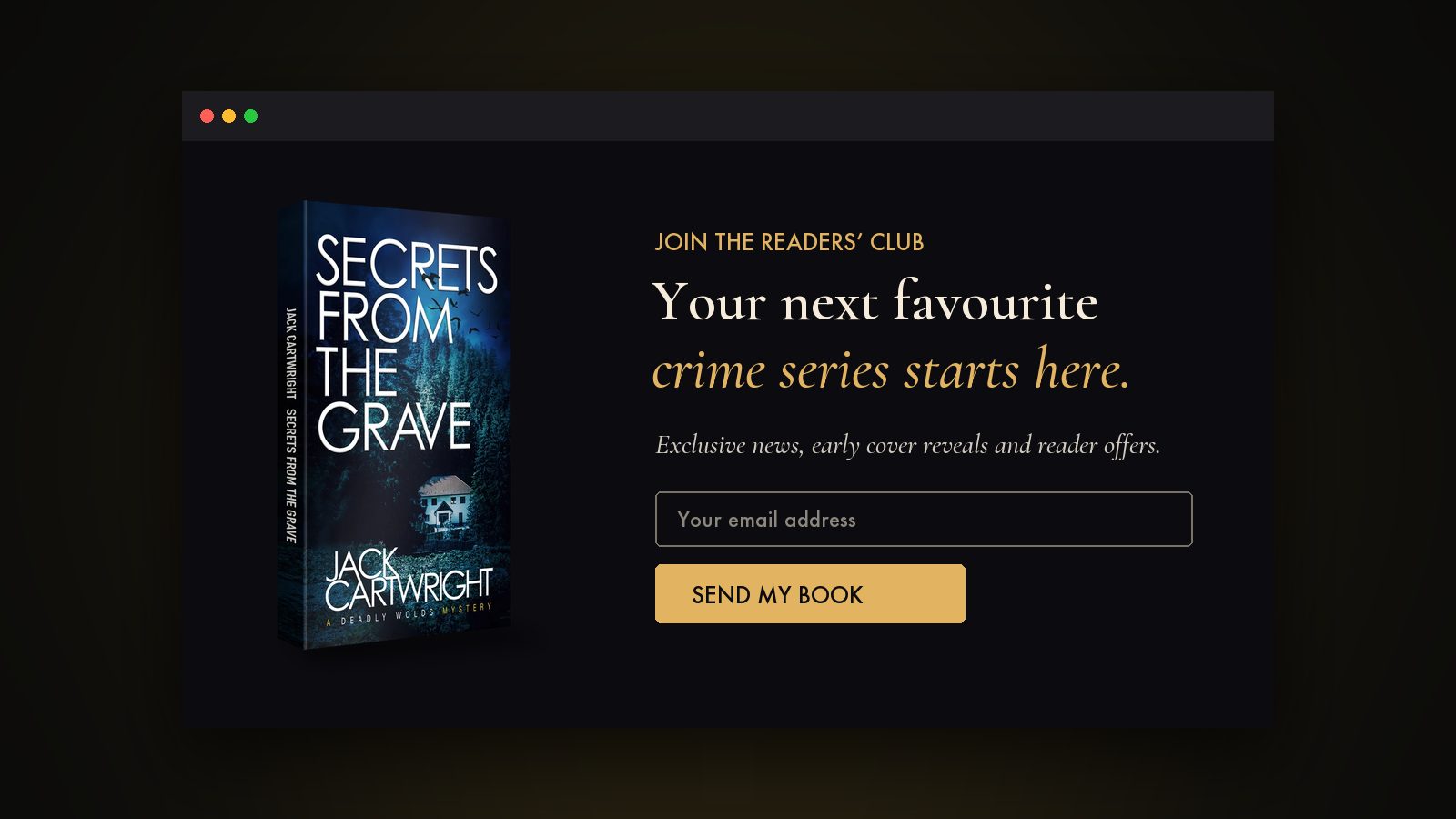
A reader magnet landing page has one job: swapping a reader’s email address for your free book. It needs a headline that promises the story. Show the cover and a short blurb. Add one sign-up form with plain consent wording and no menu. Once they sign up, deliver the book at once and start a welcome sequence introducing your series.
A reader magnet is the free book, novella or prequel you give away in return for someone joining your mailing list. Most authors have one. Far fewer have a reader magnet landing page built to give it away properly. Just linking to a delivery service’s form from the back of a book leaves readers guessing what they’re actually signing up for.
This guide is about the page itself. It covers what goes on it and how to handle consent, then what happens next and where your readers come from. It assumes you already have a magnet and want it to pull its weight, ideally on a website built for authors where the page matches the rest of your brand.
Focus. The page does one thing, so take off the site menu and the social icons, along with the list of every book you’ve ever written. A reader who turns up from an ad, a newsletter swap or the back of your book has already shown interest. Your job is to make the next step obvious.
Treat it as a short sales page with these parts, in this order:
Everything else is optional, and most things you might bolt on make the page weaker. If the book is enrolled in KDP Select, read the KDP Select terms first, because enrolled ebooks must be available digitally only through KDP for the whole enrolment period.
Say what the reader gets and what sort of story it is. “Get the free prequel to the Harbour Street crime series” tells a thriller reader the genre, that it’s free and that it’s part of a series. “Join my newsletter” tells them nothing at all. If you write in a recognisable trope or subgenre, name it. It helps the right reader say yes, and lets the wrong one leave.
Show the cover of the free book big enough to read the title, and make sure it looks like the rest of your series. If the magnet has a weak or mismatched cover, readers may judge your whole catalogue by it. A professionally designed cover for the freebie pays for itself in sign-ups.
Write it the way you would for a retailer page. Open with a hook and the stakes, then add a line that sets expectations, such as how long the read is or that it works as a way into the series. A reader who knows the length and the tone is far more likely to open the file once they’ve downloaded it.
As little as you can get away with. An email address, maybe a first name, is plenty. Every extra field costs you sign-ups. If you want to know which format a reader uses, ask after they’ve joined the list.
Make the button say what happens: “Send me the free book” beats “Submit”. Test the form on a phone, because most readers will arrive on a mobile. It should be visible without scrolling and easy to fill in with one thumb.
If you email people from the UK, the rules on marketing consent apply to you, even if your author business is just you. The ICO’s guidance on email marketing says you must not send marketing emails to individuals without their specific consent, for example a ticked opt-in box. It also describes a limited “soft opt-in” for existing customers, which it says doesn’t cover prospective customers or bought-in lists.
A few things follow from that.
The ICO notes that this guidance is under review because of the Data (Use and Access) Act, so check its page for the latest wording before you finalise your form. This isn’t legal advice. If you’re unsure, ask a professional.
This is where lots of sign-ups go to waste. The form should lead straight to a thank-you screen that tells the reader how to get the book, and the first email should deliver it within a minute or two. Explain how to open the file on a Kindle, phone or tablet, because trouble with delivery is the main reason a free book never gets read.
Then use the welcome sequence to keep your promise. Here’s a simple structure:
Keep the tone the same as your books. Readers who get to know your voice early are more likely to stick around once the emails slow down.
The back of your books is the most natural source of all, because the reader has just finished a story they enjoyed. Give a short pitch and a link or QR code to the landing page. A vague mention of “my newsletter” won’t do it.
Swapping promotions with authors who write for the same readers sends warm traffic to the page. Ask them how many readers they email, and send them a short blurb and an image that suit their audience.
Facebook and Instagram ads offering the free book are one way authors grow a list. The landing page has to match the ad closely, with the same cover and promise and the same tone. Our guide to Facebook and Instagram ads for authors explains how to set them up.
Watch what share of visitors sign up and how many of them open the first email. Change one thing at a time, such as the headline, the cover or the button wording, so you can see what made the difference.
We run reader-magnet funnels for authors, starting with the landing page and form, then the welcome sequence. Our team began as the in-house team for the USA Today bestselling author Jack Cartwright, so we know how a page like this fits into a series launch. We can design and build it as part of your author website, with the branding and consent wording set up properly. For the wider picture, see how we market self-published authors. We agree a clear brief, scope and fee with you before any work begins.
Either can work. A prequel or short novella is quicker to read and ends with a natural pointer to book one. A full series starter can convert well but gives away more of your catalogue. Pick whichever format best introduces your voice and leaves readers wanting the next book.
Use a separate page. It performs better because it has one job and nothing to distract from it. Your homepage should still carry a sign-up offer, but readers arriving from an ad, a swap or your back matter should land on a page built only for the magnet.
Yes, and you should ask for it clearly. The ICO says marketing emails need specific consent. Tell readers on the form that they’ll get emails, offer a tick box where you can, and put an unsubscribe link in every message.
Stop thinking of marketing as a cost. The moment you do, you cut yourself off from a critical arm of your business and turn it into a negative. Without a funnel, readers who enjoy your work have no way to hear about your next book, and that’s the lost opportunity. Start with a simple page and welcome sequence, and only add ads once the page converts well.
Three to five is a sensible start: delivery and a personal introduction, then the series and a gentle ask. Good emails beat lots of emails. Send enough to introduce your books properly without swamping a new subscriber, then move them onto your regular newsletter rhythm.
What should authors post between releases? A balanced mix of story, process and reader posts, series reminders, countdowns and a weekly plan.
Learn how to give every book in a series a consistent look, with colour per book, clear numbering, box set covers and refreshes that help read-through.
Why indie authors sell ebooks, paperbacks and audiobooks from their own site, how delivery works, and what to check on VAT and KDP Select first.
Four quick questions, and we’ll show you where we’d start. Your answers come straight to us with your message, so you won’t have to explain it twice.
A 30-minute introduction call on Microsoft Teams, Monday to Friday, 9am to 5pm. Your answers come with the booking, so we’ll be ready for you.
Prefer to talk it through? Make an appointment for a 30-minute call on Microsoft Teams, Monday to Friday, 9am to 5pm.
A closer look at the work behind each part of your plan.
We use analytics cookies to understand how visitors use our site. They are only set if you accept. Read our privacy policy.